A 65 in screen from 9 ft 0 in
20/20 eyes can separate about 1,010 lines
| Resolution | Lines | From your seat | All detail from |
|---|---|---|---|
| 1080p | 1,080 | Pixels too small to see | 8 ft 5 in |
| 4K | 2,160 | Looks the same as 1080p | 4 ft 3 in |
| 8K | 4,320 | Looks the same as 4K | 2 ft 1 in |
"All detail from" is the distance where one pixel row is one arcminute tall, the ITU-R BT.1845 rule. Closer than that, 20/20 eyes can make out the pixel grid.
The one arcminute rule
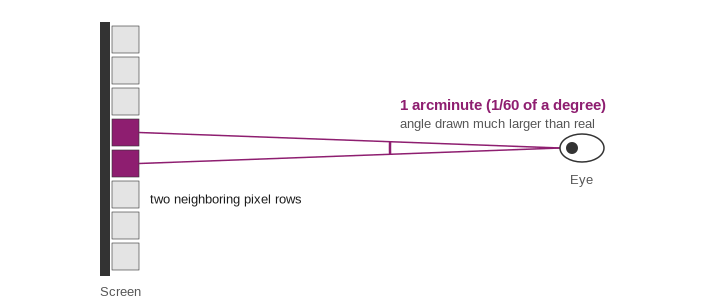
A person with 20/20 vision can just tell apart two lines that are one arcminute apart, a sixtieth of a degree. When two neighboring rows of pixels are closer than that in your view, they blur into one. ITU-R BT.1845-1 uses this rule for its optimal viewing distances: 3.2 picture heights for 1080p and 1.6 for 4K.
A 16:9 picture is 0.49 times its diagonal tall, so in terms of the diagonal the distances are:
- 1080p: pixels visible closer than 1.56 times the diagonal
- 4K: all detail visible at 0.78 times the diagonal or closer
- 8K: all detail visible at 0.39 times the diagonal or closer
Distances for common sizes
The first column is the useful one for most rooms. Closer than that distance, a 4K TV looks sharper than a 1080p TV of the same size.
| Screen | 4K sharper than 1080p, closer than | All 4K detail from | All 8K detail from |
|---|---|---|---|
| 43 in | 5 ft 7 in (1.70 m) | 2 ft 10 in (85 cm) | 1 ft 5 in (43 cm) |
| 50 in | 6 ft 6 in (1.98 m) | 3 ft 3 in (99 cm) | 1 ft 8 in (50 cm) |
| 55 in | 7 ft 2 in (2.18 m) | 3 ft 7 in (1.09 m) | 1 ft 9 in (55 cm) |
| 65 in | 8 ft 5 in (2.58 m) | 4 ft 3 in (1.29 m) | 2 ft 1 in (64 cm) |
| 75 in | 9 ft 9 in (2.97 m) | 4 ft 11 in (1.49 m) | 2 ft 5 in (74 cm) |
| 77 in | 10 ft 0 in (3.05 m) | 5 ft 0 in (1.53 m) | 2 ft 6 in (76 cm) |
| 85 in | 11 ft 1 in (3.37 m) | 5 ft 6 in (1.68 m) | 2 ft 9 in (84 cm) |
| 98 in | 12 ft 9 in (3.88 m) | 6 ft 4 in (1.94 m) | 3 ft 2 in (97 cm) |
| 100 in | 13 ft 0 in (3.96 m) | 6 ft 6 in (1.98 m) | 3 ft 3 in (99 cm) |
What this means when you buy
At 8 ft, 4K beats 1080p on sharpness from about 62 in up. At 10 ft, from about 77 in. Most new TVs are 4K anyway, so the real use of these numbers is deciding between sizes: a bigger 4K screen lets your eyes see more of the detail you're paying for.
8K is harder to justify. To see more than 4K on a 75 in TV, you'd sit closer than 4 ft 11 in. Few living rooms put the sofa that close.
What pixel count doesn't cover
- HDR and wider color come with most 4K TVs and show from any distance.
- Streaming services compress 4K harder than a 4K Blu-ray, so the source can lose detail before it reaches the screen.
- A 4K TV upscales 1080p broadcasts. From past 1.56 times the diagonal, upscaled 1080p and true 4K look much the same to 20/20 eyes.
- People with sharper eyes than 20/20 see a little more detail at each distance.
Questions
- What is the best viewing distance for a 4K TV?
- The same angle range as any TV: 1.2 to 1.63 times the diagonal, from THX's 40° to SMPTE's 30°. Within that, sit closer than 1.56 times the diagonal if you want 4K to look sharper than 1080p. On a 65 in TV that means 6 ft 6 in to 8 ft 5 in.
- How close can you sit to a 4K TV?
- At 0.78 times the diagonal, 20/20 eyes start to see 4K pixels. On a 65 in TV that's 4 ft 3 in. It's closer than THX's 40° seat, so the screen would fill more of your view than THX recommends.
- Can you tell 4K from 1080p at 10 feet?
- On a screen of 77 in or more, yes, if you have 20/20 vision. On a smaller screen, the 1080p pixels are already too small to see from 10 ft, so 4K looks no sharper.
- Is 8K worth it?
- Only if you sit very close to a very large screen. To see more than 4K offers you need to be within 0.78 times the diagonal, which is 4 ft 11 in for a 75 in TV.
- Does this apply to projectors?
- Yes. Use the diagonal of the projected 16:9 picture.