Where the 1.2 to 1.6 rule comes from
A common rule says to sit 1.2 to 1.6 times the screen size away. Those multipliers are viewing angles. A 16:9 screen is 0.87 times its diagonal wide. Sit 1.2 times the diagonal away and the screen fills 40 degrees of your view, which is the THX figure. At 1.63 times it fills 30 degrees, the SMPTE figure.
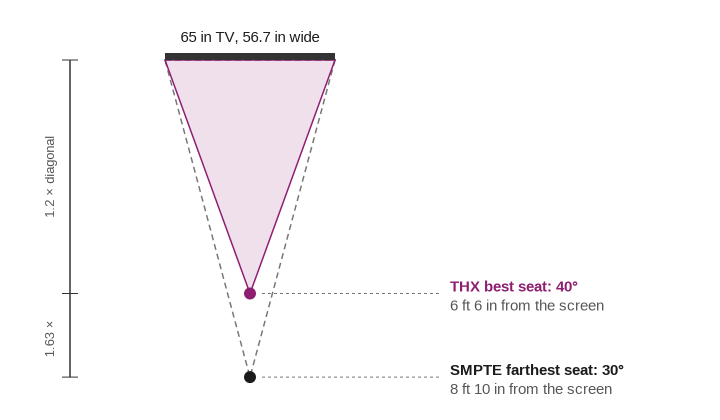
A multiplier only answers one question. The calculator works from the angle itself, so it also answers the reverse: if the sofa can't move, which TV sizes fit that distance.
The standards behind each number
- SMPTE, 30 degrees. SMPTE's engineering guideline EG 18-1994 was written for cinema design. It says the picture should fill about 30 degrees of view for the farthest viewer. SMPTE withdrew the document in 2003, but 30 degrees is still the minimum that most viewing distance guides quote. The calculator treats it as the farthest you should sit.
- THX, 40 degrees. THX puts the best seat where the screen fills about 40 degrees of your view. Wikipedia's article on viewing distance summarizes its guidance. The calculator treats 40 degrees as the closest seat in the recommended range.
- ITU-R BT.1845-1, one arcminute per pixel. The ITU defines the optimal viewing distance as the point where two neighboring pixels sit one arcminute apart in your view. Its table gives 3.2 picture heights for 1920 × 1080 and 1.6 picture heights for 3840 × 2160 (Recommendation ITU-R BT.1845). The calculator applies the same rule to 1080p, 4K and 8K.
- 20/20 vision. One arcminute is the finest detail that a person with 20/20 (6/6) vision can just make out. Plenty of people, younger ones especially, see finer detail than that. The resolution figures are for average eyesight, and sharp eyes will see a little more.
How to measure your setup
- Screen size is the diagonal of the picture, the number in the model name. A 65 in TV is 65 inches from one corner of the picture to the opposite corner, frame not included.
- Measure to your eyes, not to the front of the sofa. Sit the way you usually watch, lean back, and measure from the screen to your head. Deep cushions and recliners put you further back than the sofa's front edge suggests.
- If people sit at different distances, run the farthest seat and then the nearest. A good size keeps the far seat at 30° or more and the near seat at 40° or less.
1080p, 4K and 8K at ordinary distances
Resolution only helps if your eyes can separate the extra pixels. Take a 65 in TV. Past 8 ft 5 in, 20/20 eyes can't make out 1080p pixels on it, and SMPTE's 30° seat for that TV is 8 ft 10 in. So at the far end of the range, 4K looks about as sharp as 1080p would. From THX's 40° seat at 6 ft 6 in, 4K does look sharper, though seeing every 4K pixel takes 4 ft 3 in or closer.
This pattern holds at every size, because both distances scale with the screen. 1080p pixels vanish at 1.56 times the diagonal and SMPTE's seat is at 1.63 times. A 4K TV can still look better from the back of the room for other reasons, such as HDR and wider color, which most 1080p sets don't have. The 4K viewing distance page has a table for each common size.
Room by room
Small living room or apartment
With the sofa 6 ft from the screen, SMPTE's 30° gives 44 in and THX's 40° gives 60 in. A 50 or 55 in TV sits in the middle of that range. At 7 ft the range is 52 to 70 in.
Large living room
At 10 ft the range runs from 74 to 100 in. Below 77 in, a 4K picture won't look sharper than 1080p from that far. The TV size by distance chart lists every foot from 4 to 16.
Sectional or L-shaped sofa
The calculator assumes you sit facing the middle of the screen. Someone in the corner seat sees the screen at an angle, so it looks narrower to them. Measure the seat you use most, then check the farthest one.
Bedroom
Measure from where your head rests on the pillow. Height matters more here, because you look at the screen from a raised, half-lying position. The mounting height calculator takes your eye height into account.
Projector screen
The same angles apply to a 16:9 projector screen. Enter the screen's diagonal. Cinemascope screens (2.35:1 or 2.39:1) are wider for the same diagonal, so the results won't fit them.
Questions
- How far should I sit from a 65 inch TV?
- Between 6 ft 6 in and 8 ft 10 in (2.0 to 2.7 m). At 6 ft 6 in the screen fills 40° of your view, the THX figure. At 8 ft 10 in it fills 30°, the SMPTE minimum. For 4K to look sharper than 1080p, sit closer than 8 ft 5 in.
- How far should I sit from a 55 inch TV?
- Between 5 ft 6 in and 7 ft 5 in (1.7 to 2.3 m). 4K looks sharper than 1080p from closer than 7 ft 2 in.
- How far should I sit from a 75 inch TV?
- Between 7 ft 6 in and 10 ft 2 in (2.3 to 3.1 m). 4K looks sharper than 1080p from closer than 9 ft 9 in.
- What size TV for a 10 foot viewing distance?
- 74 to 100 inches by the SMPTE and THX angles. The common sizes in that range are 75, 77, 83, 85, 98 and 100 in. From 10 ft, a 4K picture only looks sharper than 1080p on a screen of 77 in or more.
- What size TV for an 8 foot viewing distance?
- 59 to 80 inches, so 65, 70, 75 or 77 in.
- Is 4K worth it if I sit far from the TV?
- For sharpness alone, only if you sit closer than 1.56 times the screen diagonal. Farther than that, 20/20 eyes can't see 1080p pixels, so the extra 4K pixels add nothing you can see. 4K TVs often have better HDR and color, which you can see from any distance.
- Do the distance rules change for 4K TVs?
- The angle guidelines stay the same. Resolution only changes how close you can sit before you see pixels: 1.56 times the diagonal for 1080p and 0.78 times for 4K. That's why a 4K TV can be bigger for the same seat without looking grainy.
- How high should I mount my TV?
- Put the middle of the screen near your eye height when seated. THX advises that you shouldn't have to look up more than 15 degrees. The mounting height calculator works it out for your seat and screen.
- Does the calculator work for monitors?
- The maths works for any 16:9 screen, but SMPTE's and THX's figures were written for film and TV. People at a desk usually want the screen smaller in their view so they can read the corners without turning their head.